


Wholesale Latin Products for Small Retailers

Updated: Oct 2
A small grocery store can lose a repeat customer over one missing item. It may be a familiar corn flour, a specific dried chile, a lunchbox snack, or a beverage brand that customers expect to find every week. That is why sourcing wholesale Latin products for small retailers is not simply about filling shelf space. It is about carrying products that feel recognizable, dependable, and worth returning for.
For independent grocers, specialty markets, convenience retailers, and foodservice operators, the right wholesale partner helps make Latin product buying more practical. The goal is to maintain authentic variety without tying up cash in oversized orders, inconsistent supply, or slow-moving inventory.
What Small Retailers Need From Latin Product Wholesale
Large retailers can absorb broad inventory commitments and long purchasing cycles. Small retailers often cannot. They need products that serve a clear customer demand, arrive through a reliable local distribution schedule, and can be reordered without unnecessary pressure to buy more than their shelves can support.
Authenticity comes first. Latin American customers often know the brands, formats, flavors, and ingredients they are looking for. A generic substitute may not meet the same expectation. At the same time, non-Latin shoppers are increasingly looking for established products that introduce them to Mexican, Colombian, Central American, and South American pantry staples in a credible way.
Consistency is equally important. A strong product assortment should include familiar everyday items as well as discovery items that encourage larger baskets. The balance depends on the store. A neighborhood grocery serving established Latin households may prioritize core pantry goods and recognizable snack brands. A specialty retailer with a broader customer base may use the same staples as a foundation, then add sauces, sweets, and beverages that invite trial.
Flexible purchasing matters because demand is rarely uniform. Some products move every day, while seasonal gatherings, holidays, school schedules, and local events can change what customers buy. A distributor that offers no minimum order gives retailers more control over their inventory investment. Instead of ordering excess cases to satisfy a threshold, buyers can replenish according to actual movement.
Build a Core Assortment Before Expanding
The most effective Latin product section does not begin with the largest possible assortment. It begins with reliable essentials that customers recognize and use regularly. Once those products are established, retailers can expand based on repeat demand, shelf performance, and customer requests.
Pantry staples create dependable repeat sales
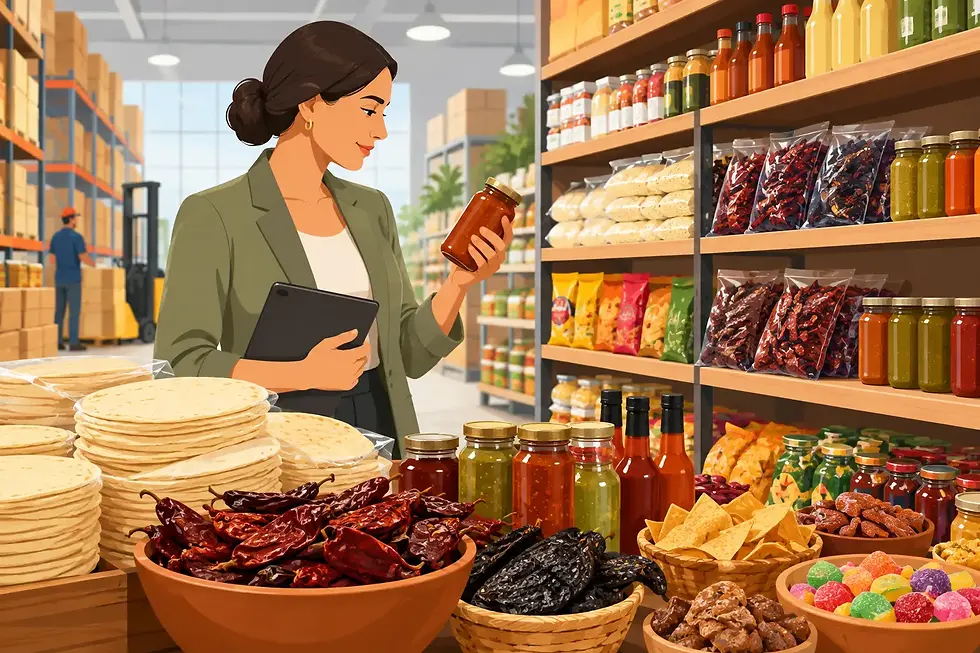
Tortillas, corn flour, grains, condiments, dried chiles, seasonings, soups, and sauces form the working foundation of many Latin grocery assortments. These categories are practical because they support frequent household purchases and give shoppers reasons to return. They also offer useful cross-merchandising opportunities without requiring a store to carry an excessive number of niche products.
Within pantry categories, brand familiarity can matter as much as price. Shoppers who grew up with a particular product often look for the package, flavor profile, and format they already trust. Retailers should prioritize products with a clear purpose and recognizable value rather than stocking several similar items with no obvious reason for each to be there.
Snacks and sweets bring traffic and impulse purchases
Chips, spicy snacks, cookies, candy, and packaged sweets can deliver strong visibility near checkout areas, beverage coolers, or high-traffic aisles. These products appeal to regular customers looking for familiar treats and to curious shoppers trying something new.
This category benefits from variety, but it still requires discipline. Start with well-known brands and a controlled mix of flavors and package sizes. Watch which items are replenished quickly and which products generate customer questions. A smaller selection that turns consistently is usually more valuable than a crowded display with slow-moving inventory.
Beverages complete the shelf set
Beverages are often a practical add-on purchase. They can complement snack displays and help retailers create an assortment that feels complete rather than limited to dry grocery items. Different package sizes can serve different shopping occasions, from single-serve purchases to take-home needs.
The trade-off is space. Beverage cases and coolers take up valuable room, so buyers should choose based on their store format and available storage. If refrigeration is limited, focus on products with proven customer demand and maintain a rotation that keeps displays organized.
How to Choose Products That Fit Your Store
A broad Latin catalog is valuable, but not every product belongs in every retail setting. Small retailers make better buying decisions when they consider customer profile, shelf capacity, turnover, and product role before placing an order.
Start with what customers already request. Direct requests are useful buying signals, especially when several shoppers ask for the same item or category. Staff should keep simple notes on requests, including the product type, preferred brand if mentioned, and how often it comes up. This prevents purchasing decisions from relying on memory alone.
Next, look at product velocity. Fast-moving basics deserve steady replenishment. Slower specialty items may still be worth carrying if they differentiate the store, but they should be purchased in quantities that match realistic demand. There is no advantage in filling shelves with products that consume cash and storage space for months.
Also consider the role each item plays. Some products bring shoppers into the store because they are hard to find elsewhere. Others increase basket size because they are convenient additions. A dependable assortment needs both, but core staples should receive the most shelf attention.
Inventory Control Without Overbuying
Inventory control is where wholesale flexibility becomes especially valuable. Retailers need enough stock to avoid empty shelves, but not so much that they create avoidable waste, clutter, or cash-flow pressure. This is particularly relevant for products with dated packaging, seasonal demand, or limited storage capacity.
A practical approach is to separate products into three groups: dependable staples, regular secondary sellers, and test items. Dependable staples should be reviewed often and reordered before shelves look depleted. Secondary sellers can be reviewed on a regular cycle based on sales. Test items should be brought in deliberately, with a clear decision point about whether they deserve permanent shelf space.
Delivery schedules also shape good ordering habits. Retailers served across the GTA, Kitchener-Waterloo, and London can plan replenishment around scheduled weekday routes rather than trying to solve every stock gap with a large one-time purchase. Product pickup near Highways 404 and 401 in Markham can also be useful when a buyer needs to restock around their own operating schedule.
The key is not to order less at all costs. It is to order with purpose. A retailer that knows its core items, keeps an eye on turnover, and has access to flexible order quantities can maintain a fuller-looking shelf with less unnecessary inventory.
Why Vendor Relationships Affect Retail Performance
Wholesale buying is not only a product decision. It is also an operational relationship. Small retailers benefit from suppliers that understand the categories they carry, communicate clearly about availability, and source through established relationships with Latin American and U.S. vendors.
Responsive communication is especially valuable when customers request a new item, a store needs to adjust an order, or demand shifts unexpectedly. Buyers should expect accurate product information, straightforward ordering support, and a distributor that recognizes the difference between a staple item and a specialty request.
Quality standards matter as well. Authentic Latin products are tied to familiar flavors, household traditions, and trusted brands. When a retailer stocks products from established suppliers, it protects customer confidence in the store's selection. That confidence is difficult to build and easy to weaken when products are inconsistent or poorly matched to what customers expect.
A Smarter Way to Grow a Latin Product Section
Growth should follow demand, not assumptions. Once core staples, snacks, sweets, and beverages are moving reliably, expand into adjacent categories such as natural products, health care items, cleaning products, fish, or additional regional specialties. Each addition should have a reason: a customer request, a clear category gap, or a product that complements what already sells.
Merchandising can help the assortment work harder. Keep pantry items easy to compare, group related snack and beverage products where practical, and make sure familiar brands are visible. Clear organization helps customers shop faster and helps staff spot low inventory before it becomes an empty shelf.
For restaurants, grocers, and retailers that need authentic Latin products with flexible purchasing, Terragusto offers competitive wholesale selection with no minimum order. Review the product catalog or contact page to discuss ordering for the GTA, Kitchener-Waterloo, or London. Call 905-477-4630 or email info@terragusto.ca. The best next order is the one that keeps your regular customers confident that the products they came for will be there.


Comments